Social Simulation Laboratory

Understanding connections. Exploring social change.

Complex social dynamics emerge from connections among people and firms. We combine real-world data with network science, machine learning, and simulation to understand and predict phenomena in the economy, transportation, and innovation, and to explore choices for a better society.

Professor Hiroyasu Inoue

Information

Please contact me via email: inoue at gsis.u-hyogo.ac.jp.
Recently, a lot of emails have been rejected by a filter. Since I always reply to all mails, please try sending a mail from a different address if you have not received my reply.


News

On October 23, 2026, Hiroyasu Inoue presented at the Vietnam Symposium in Banking and Finance 2026 (VSBF 2026) in Hanoi, Vietnam.

The presentation, “News Sentiment and Stock-Price Comovement across Global Customer–Supplier Relationships,” is joint work with Yasuyuki Todo.

News about a company may matter not only for that company but also for its suppliers and customers. This research examines how news sentiment relates to stock-price comovement among firms connected through global customer–supplier relationships. By focusing on supply-chain connections, the study seeks to better understand how information spreads across firms in financial markets.
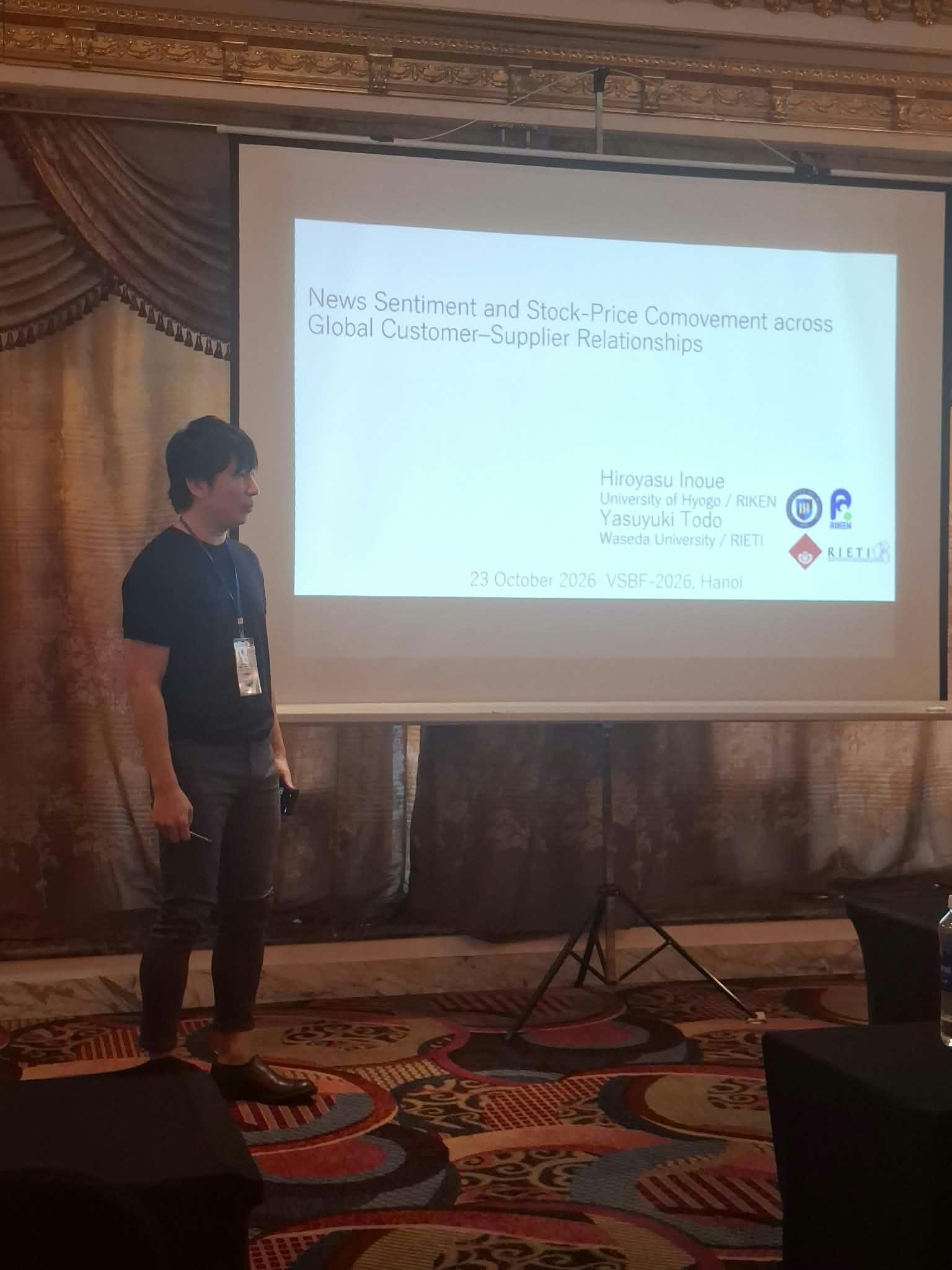
Hiroyasu Inoue presenting at VSBF 2026 in Hanoi
Presentation at VSBF 2026 (October 23, 2026, Hanoi)

Official conference program

On October 21, 2026, Hiroyasu Inoue presented research results at a reporting meeting for projects supported by the Watanabe Memorial Foundation for the Advancement of New Technology, held at Hosokai Kaikan in Tokyo.

The presentation was titled “Analysis of Urban Development Based on Technological Complexity Using Long-Term Patent Data.” Supported by the foundation’s research grant, the study uses historical patent data to examine the relationship between technological complexity and urban development. It aims to improve our understanding of regional development by focusing on the technological capabilities accumulated in different cities.

Foundation’s list of supported projects (Japanese)

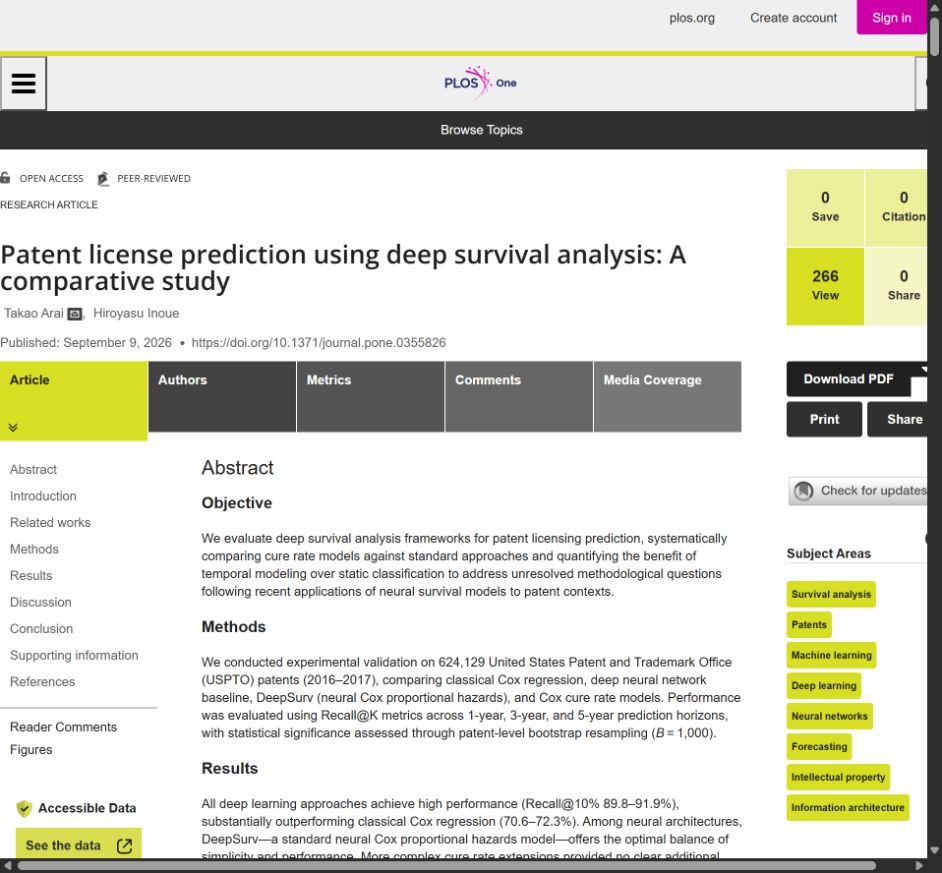
The paper by Arai Takao and Hiroyasu Inoue was published in PLOS One on September 9, 2026.

Finding commercially promising inventions among the many patents held by companies and universities requires costly expert review. Licensing provides evidence of commercial value. Predicting which patents are likely to be licensed can help prioritize candidates for closer assessment and technology transfer.

We compared four methods using 624,129 US patents, predicting licensing within one, three, and five years. Because a patent that has not yet been licensed may be licensed later, we combined deep learning with survival analysis, which accounts for the time until a licensing event.

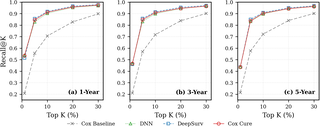
The relatively simple DeepSurv model performed comparably to more complex alternatives. In this evaluation, selecting the top-ranked 10% captured about 91% of licensed patents. The findings suggest that learning informative patent features matters more than adding model complexity, offering practical guidance for screening large patent portfolios.

Fig 3: Recall@K comparison across four models and three prediction horizons
Fig 3: Prediction performance comparison. Arai & Inoue (2026), PLOS One, CC BY.
The article page on PLOS One
Article page on PLOS One

Read the paper (open access)

Research interests

Network science

Social simulation

Artificial intelligence

MEMBERSHIP

International Network for Social Network Analysis

Information Processing Society of Japan

Japan Association for Evolutionary Economics

LABORATORY

Graduate School of Information Science
University of Hyogo

Computational Science Center Building
7-1-28 Minatojima-minamimachi, Chuo-ku
Kobe, Hyogo 650-0047, Japan