Recent Activities

Rintaro Karashima, a fourth-year undergraduate student, presented at the 19th Network Ecology Symposium. His presentation examined the evaluation of Japanese corporations using a knowledge complexity index.

Presenting research outside the university while still an undergraduate is a commendable achievement.


Comments by Hiroyasu Inoue appeared on the front page of Nikkei, discussing the economic damage caused by disasters and ways to reduce it.

Related article / information

A paper coauthored by Hiroyasu Inoue and Yasuyuki Todo has been published in PLOS ONE.

Entitled “Disruption of international trade and its propagation through firm-level domestic supply chains: A case of Japan,” the paper examines how shocks to international trade propagate through supply chains and considers effective ways to mitigate their effects.

Read the paper

I was invited by the Senri Life Science Foundation to give a lecture. It was a very meaningful time for me as I had a chance to talk directly with Dr. Kishimoto, a Nobel Prize nominee in the field of drug discovery.
The topic was “Large-Scale Simulation of Economy Using Large-Scale Computers.

“Propagation of Overseas Economic Shocks through Global Supply Chains: Firm-level evidence” was presented as a discussion paper at the Research Institute of Economy, Trade and Industry (RIETI), an independent administrative agency under the jurisdiction of the Japanese Government.
This paper analyzes the impact of international supply chain disruptions on Japan by adding information on individual firms’ imports and exports to domestic supply chain data.

“Lockdowns Require Geographic Coordination because of the Propagation of Economic Effects through Supply Chains ” was presented as a discussion paper at the Research Institute of Economy, Trade and Industry (RIETI), an independent administrative agency under the jurisdiction of the Japanese Government.
This paper analyzes how much Japan is affected by international supply chain disruptions by adding information on individual firms’ imports and exports to the domestic supply chain data in COVID-19.

“Establishment-level Simulation of Supply Chain Disruption: The case of the Great East Japan Earthquake” was presented as a discussion paper at the Research Institute of Economy, Trade and Industry (RIETI), an independent administrative agency under the jurisdiction of the Japanese Government.
In this paper, we present a Bayesian optimization approach to find parameters for a domestic supply chain simulator that can reproduce the Great East Japan Earthquake by integrating not only corporate headquarters but also business office data from the Economic Census, a government statistic.

Our research proposal entitled “Refinement of Large-Scale Supply Chain Simulation Estimates of Economic Damage Caused by Earthquakes and Infectious Diseases” has been selected by the Japan Securities Scholarship Foundation for a research grant program for fiscal year 2022.

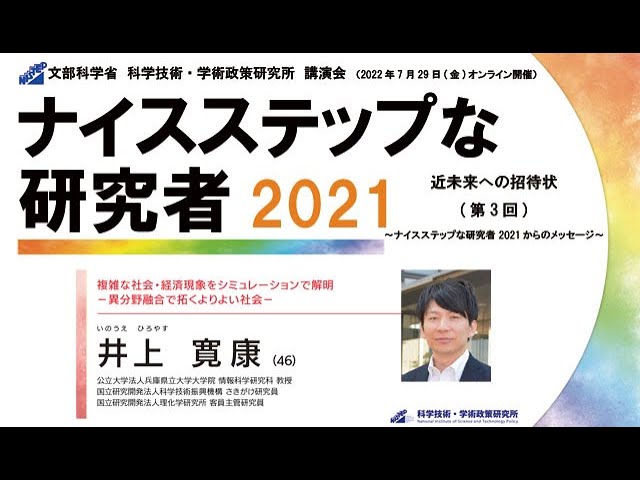
Selected as one of the 2021 NISTEP researchers by the National Institute of Science and Technology Policy, Ministry of Education, Culture, Sports, Science and Technology, I gave a lecture.

1 2 3 4 5 … 14