
Archived announcement from 2022.
The laboratory advertised a part-time researcher position in the Graduate School of Information Science, welcoming applicants interested in social simulation. Details were provided through the JREC-IN Portal.
Archived announcement from 2022.
The laboratory advertised a part-time researcher position in the Graduate School of Information Science, welcoming applicants interested in social simulation. Details were provided through the JREC-IN Portal.
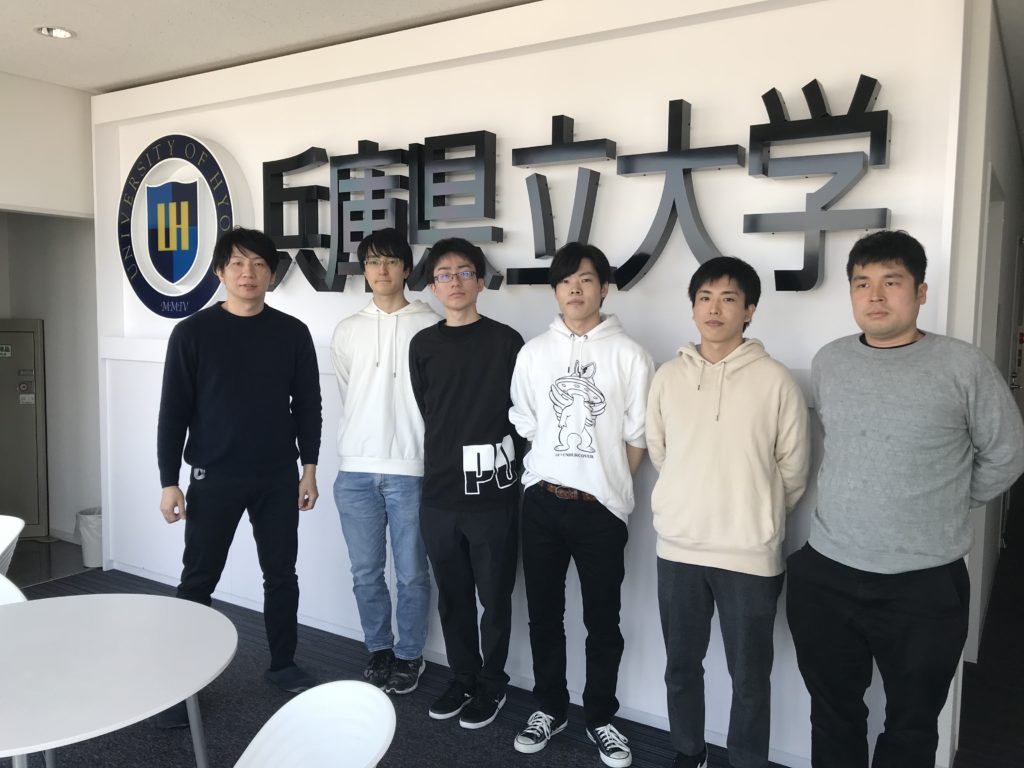
With the start of FY2022, Mr. Katsumi Tamaki and Mr. Shota Hayakawa joined our lab. Welcoming more and more students, we would like to pursue synergistic, interesting, and high-quality research.
Prof. Inoue received a four-year grant for Developmental Research in the field of Humanities and Social Sciences for the analysis of pandemic resilience through simulation on a comprehensive B-to-B trading network. “I feel honored to receive this grant from the prestigious Asahi Glass Foundation”, Prof. Inoue said.
Mr. Hiroto Nakagori and Mr. Ryuki Yamamoto, first-year master students from our lab, gave presentations at the Physical Society of Japan.
Below are their research topics.
Hiroto Nakagori, Hiroyasu Inoue, Daigo Umemoto, and Nobuyasu Ito, “Traffic Volume Prediction Using Neural Network Considering Spatio-Temporal Characteristics,”
The 77th Annual Meeting of the Japan Physical Society, 2022/3/15-19.
Ryuki Yamamoto, Hiroyasu Inoue, Daigo Umemoto, and Nobuyasu Ito, “Verification of effectiveness of automated vehicles in urban traffic using traffic simulation” The 77th Annual Meeting of the Japan Physical Society, 2022/3/15-19.
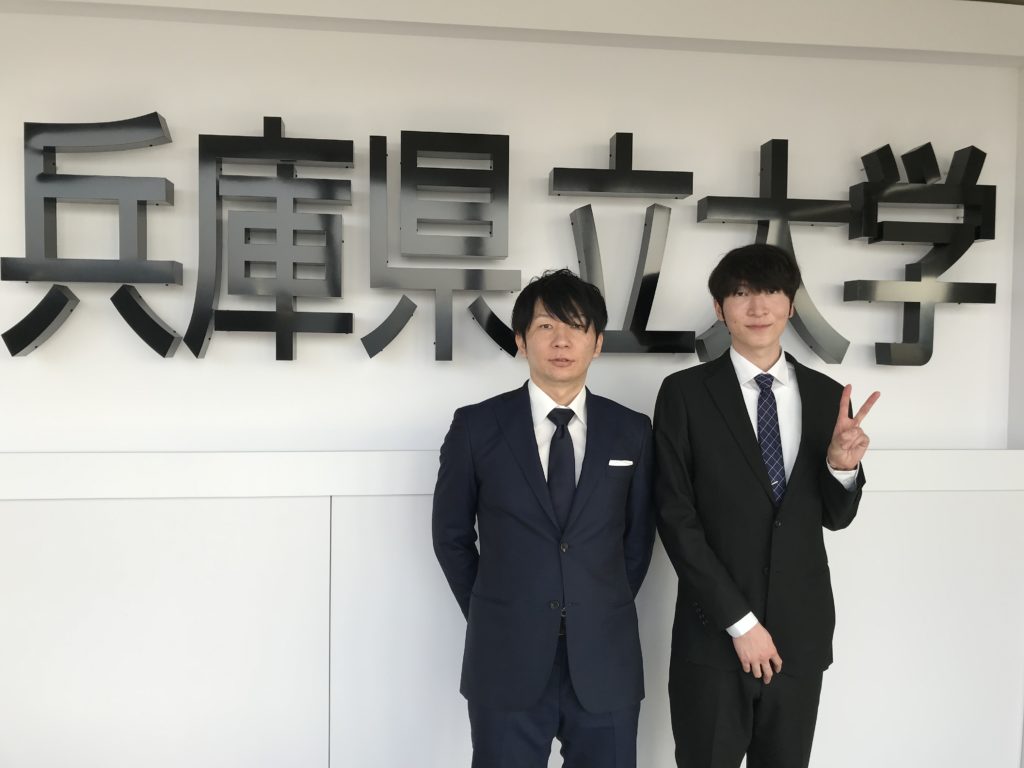
Mr. Yamato completed his master’s course. He worked on classifying Twitter data into political affiliations with machine learning. He worked hard to advance his study based on the research topic he had selected by himself. I believe he has learned a lot from his struggle and the experience would be useful for his future.
Using the Difference In Difference methodology during the Spanish flu pandemic, the study carefully examines how joint application activities were inhibited by the pandemic.
This is the first empirical study in Japan we developed based on the long-term, since the Meiji period, patent data. The study provides valuable insights useful for studies on the effect of the COVID-19 situation. I feel very honored to be added to the list of co-authors of this Dr’Nakajima’s outstanding study.
The Role of Face-to-face Contact in Innovation: The Evidence from the Spanish Flu Pandemic in Japan
INOUE Hiroyasu (University of Hyogo) / NAKAJIMA Kentaro (Faculty Fellow, RIETI) / OKAZAKI Tetsuji (Faculty Fellow, RIETI) / SAITO Yukiko (Senior Fellow (Specially Appointed), RIETI)

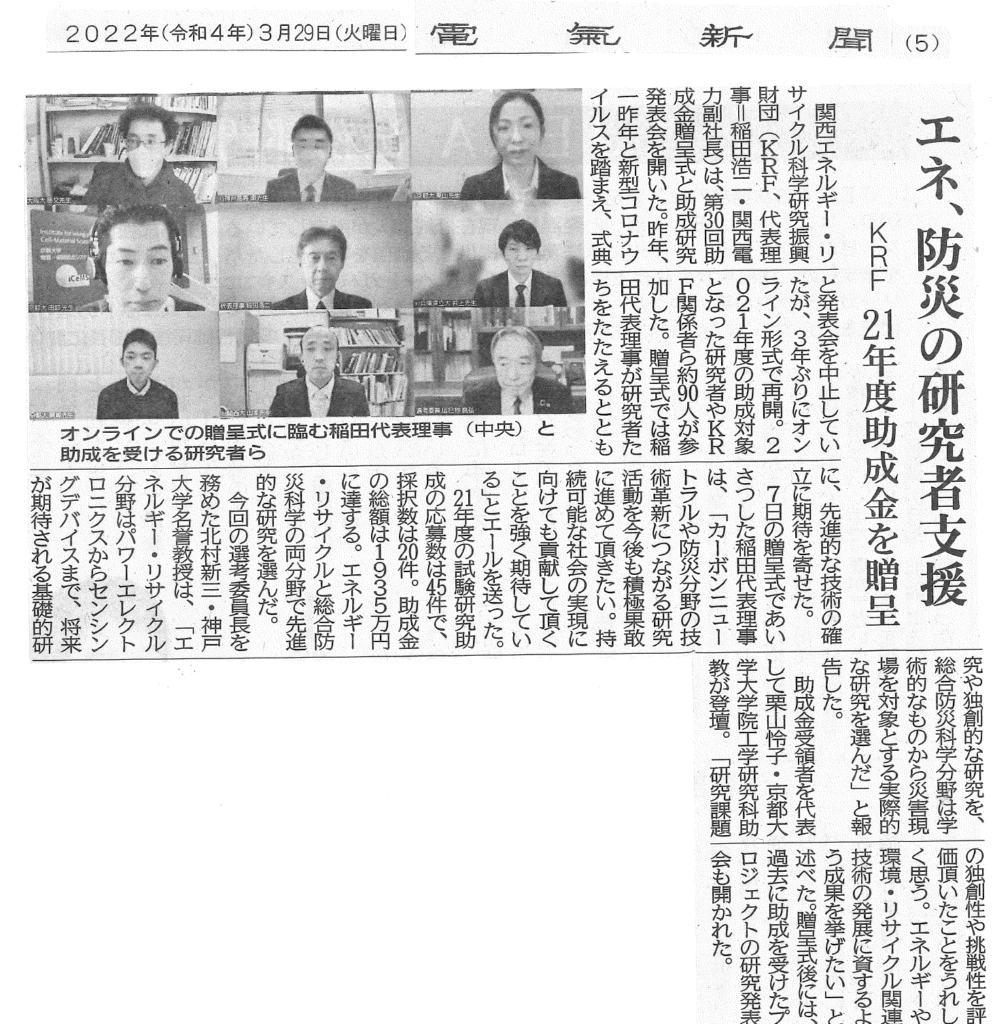
Prof. Inoue’s research project received a FY2021 experimental research grant. Below is an article published in Denki Shimbun on March 29, 2022.
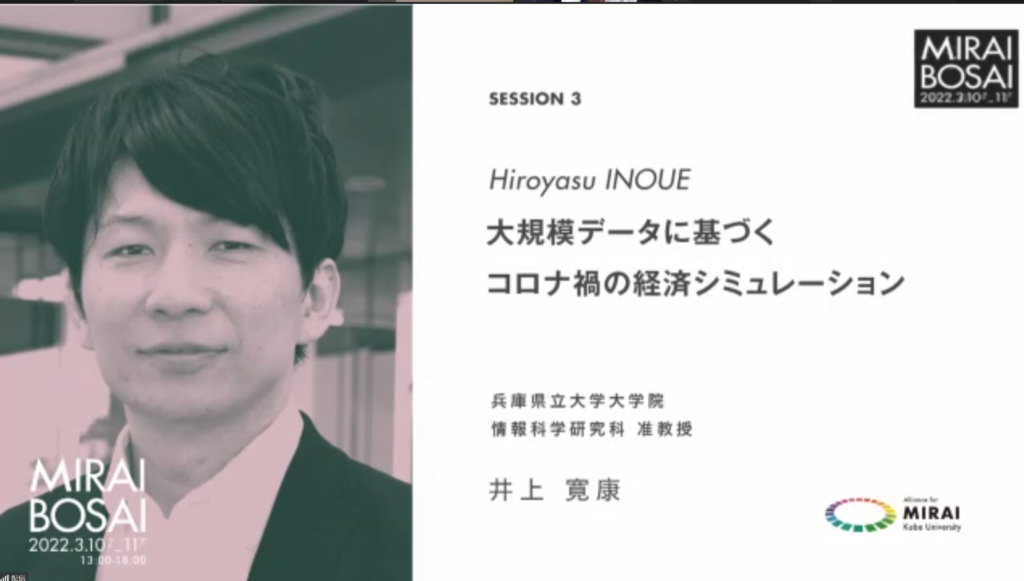
Prof. Inoue gave an invited lecture and participated in a panel discussion with Dr. Ohji (Kobe Univ.) and Dr. Onishi (AIST) at the large-scale event Mirai Bosai 2022 held at Kobe University. There was an in-depth discussion about how society would be affected by COVID-19 and how new technologies such as simulation would play a role in the post-COVID 19 era.
Prof. Inoue published a new research paper “Has COVID-19 Permanently Changed Online Consumption Behavior?” (Co-authored with Prof. Todo of Waseda University)
We examined how Japanese consumer behavior changed due to the COVID-19 pandemic based on all long-term purchase data from Yahoo Shopping data. Many say “The COVID-19 pandemic has changed what consumers buy.”, but the results of this study clearly refuted those predictions. Although people made panic purchases in quantity at the beginning of the COVID-19 outbreak, we found that after the second and third waves, people’s purchases returned to the purchasing patterns they had before the outbreak of COVID-19. We also found that there was also little qualitative change in purchasing during the two-years of the pandemic.

